
A Brief Demonstration of how Neuroscience Substantiates Counselling Practice

Eye contact in counselling; An example of when it might be one sided.
Eye contact is often highlighted as an important part of engagement with an other. When I am counselling others my gaze is focused on the eyes of the person sitting in the other chair; ‘my client’. This is regardless of whether they are looking at me. It is as if I am saying to them I am here, ready, attentive and available for you.
However it is more usual for them, in times of deep reflection to have their eyes averted, almost glazed over.
I noticed myself doing the same, glazing over, when trying to describe to a friend, how I might feel if I could sail. I was trying to describe the sensation of being at one with the boat optimising the energy of the wind. I was disengaged from eye contact but became aware of this only after I had formed the words and understood what it was that I was wanting to express. It was then that I was reminded of the work of John Kounios and Mark Beeman, on the neuroscience of insight and why I believe so passionately about listening to our own experiences, and facilitating insightful moments. 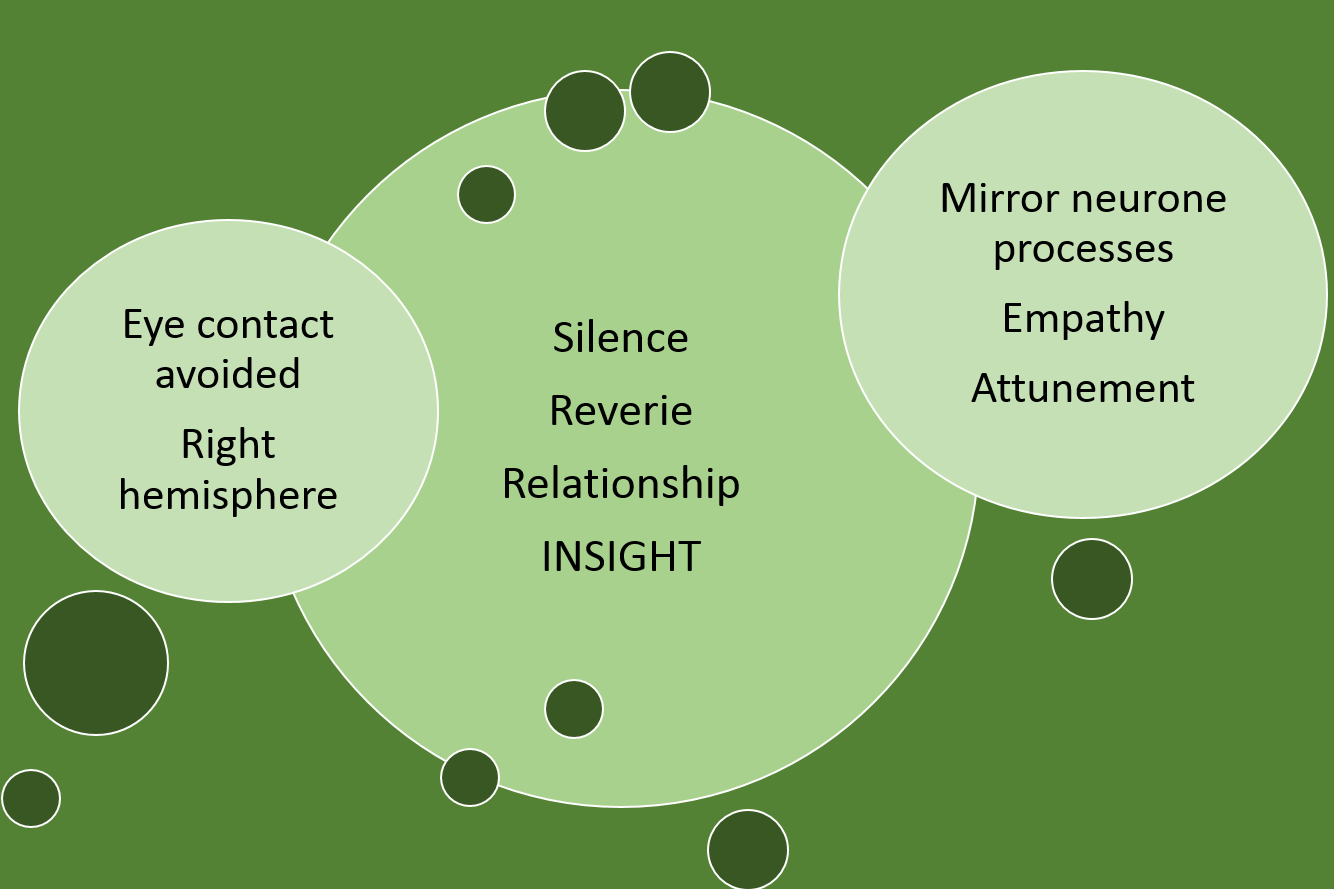
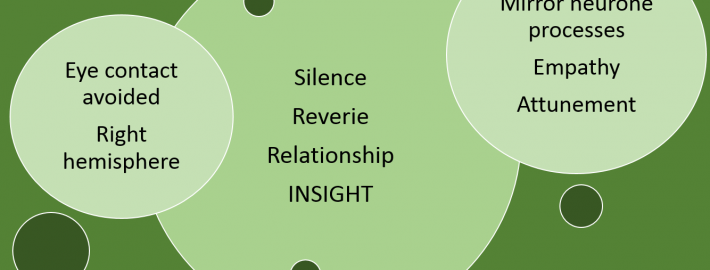
Neuroscience is tending to indicate that insightful solutions to problems occur when the right hemisphere of the brain, notable the anterior superior temporal gyrus, is active, working creativity, and the left brain becomes less active- not working at interpreting external, in particular visual stimuli. This is seen clearly when my clients look away and appear ‘vacant’. This is why holding silence can be so powerful, it allows the right hemisphere priority to act on stimuli from the prefrontal cortex and the limbic system where emotion, non-verbal activity is shown to occur. Getting in touch with our feelings and experiences. Then, once some sense has been made, the left hemisphere, logic and language come into play and the state of introspection returns to engagement and ideas are articulated and a clarity follows. Client’s and counsellor’s eyes then meet, as if to provide assurance that the experiences are valid.
It is during the silence, when I as a counsellor have been fully available, I too have been using the right side of my brain. Activity of mirror neurones in the here and now, combined with personal experiences based on my attachment history will inform me in a way that enables me to show empathy. When my client articulates her reflections I too am in tune with the implications and emotions that these generated and our counselling relationship deepens and work progresses.
I believe, psychotherapists who practice reverie and/or use the impact of clients on their sense of self, either as countertransference or somatic experiences, even in dreams or in the supervision process are demonstrating how powerful it can be to allow our right-sided creative, emotional brain to speak to us. The antithesis of active problem solving, where we consciously piece the clues together, reverie allows the insights to suddenly arise within the process of being in relationship.
It continues to surprise me when counsellors are fearful of the work of neuroscience which is helping us to understand the work we know can happen in counselling. This brief exploration of insight, demonstrates how concepts from other models for example reverie, relational depth, empathy, dream work and Gestalt ideas can all be substantiated at least in part by science, this is a wonderful truth that endorses psychotherapy and counselling as an effective means of helping people to understand themselves, come to terms with this and make use of experience to reach whatever goals they are aiming for.